
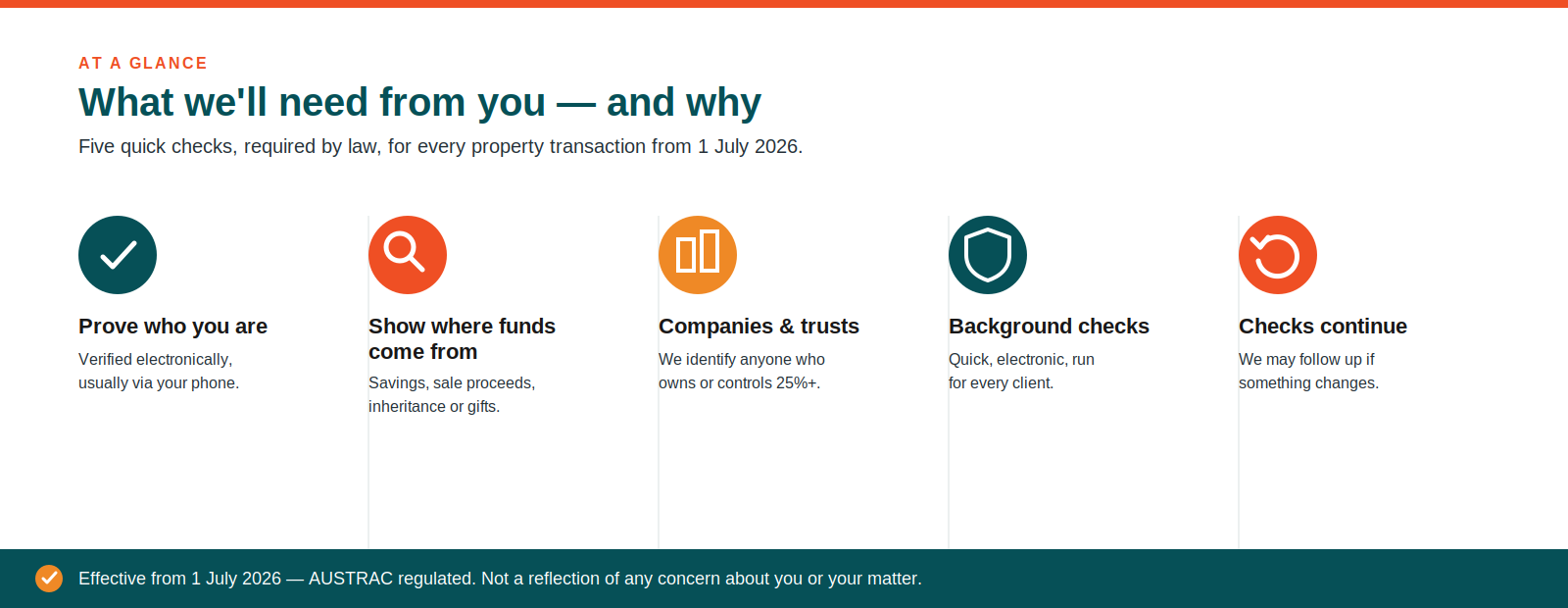
From 1 July 2026, all conveyancers and law firms in Australia must follow Anti-Money Laundering laws. Here's what that means for your property matter — in plain English.
Prove who you are
We verify your identity electronically using government databases — usually via your phone. You may need to provide more documents than in a previous purchase.
Tell us where the money comes from
We'll ask about the source of your funds — savings, sale of another property, inheritance, family gift, etc. This is asked of everyone, without exception.
Companies & trusts
Buying through a company, trust, or SMSF? We need to identify the real people behind it — usually anyone who owns or controls 25% or more.
Background checks
We run automated checks against government watch lists. It's quick, electronic, and done on every client without exception.
Checks continue throughout
Our obligations don't stop after onboarding. We may ask follow-up questions if something changes during your matter. This is completely normal.
Your privacy is protected
We collect only what the law requires. Your data is stored securely under the Privacy Act 1988 and kept for 7 years before being securely destroyed.
One important thing to know: If we ever delay, decline, or stop acting without a full explanation, we may be legally prevented from telling you why. If we report a matter to AUSTRAC (the federal financial intelligence agency), the law prevents us from disclosing that we've done so. This is called "tipping off" and carries criminal penalties. It's the law — not us being evasive.
Why am I being asked all these questions?
From 1 July 2026, new Anti-Money Laundering and Counter-Terrorism Financing (AML/CTF) laws apply to law firms and conveyancers across Australia, including here in NSW. These laws are part of a worldwide effort to stop criminals from using property transactions to hide illegal money or fund terrorism.
What this means in practice is that our firm is now what the law calls a “Reporting Entity.” We have new legal duties to check who our clients are, where their money comes from, and to keep an eye out for anything that looks unusual.
We know it can feel like a lot of extra paperwork, especially if you’ve bought or sold property before and didn’t have to do this. Please understand we’re not being difficult — we’re required by law to ask these questions, and the same rules now apply to every law firm and conveyancer in the country. The sooner we can complete these checks; the sooner we can get on with your matter and meet your settlement date.
What we need from you before we can start
Before we can begin work on your property matter, we need to:
- Confirm who you are by checking your ID
- If you’re buying or selling through a company, trust, SMSF or partnership, identify the real people behind it (the law calls these “beneficial owners” — usually anyone who owns or controls 25% or more)
- Understand what the matter is about and where the money is coming from
- Run some background checks to make sure you’re not on any government watch lists
- Assess the risk level of your matter and write that down on our file
We use a system called InfoTrack/TriSearch to do most of this electronically — it’s quick and you can usually verify your ID using your phone. If for some reason we can’t do it electronically, we’ll ask you to attend our office but mutual appointment where we will assist you in carrying out your ID verification electronically.
What’s different from last time you bought or sold
If you’ve bought or sold property before, you’ll already be familiar with Verification of Identity (VOI). The new rules go a bit further than that. You can expect us to ask about:
- Your identity — We may need to see more documents than before, or check your details against government databases.
- Who’s really behind the transaction — If you’re buying or selling through a company or trust, we need to know who actually owns or controls it, not just whose name is on the paperwork.
- Where the money is coming from — For some transactions, we have to ask where your funds came from (savings, sale of another property, inheritance, gift from family, etc.). This isn’t us being nosy — it’s a legal requirement, and we have to ask everyone.
Using the Document Verification Service
To check your ID, we may use the Australian Government’s Document Verification Service (DVS) through InfoTrack. This lets us electronically confirm that your passport, driver licence, Medicare card, birth certificate or citizenship certificate are genuine and match government records.
By signing this document, you’re telling us:
- You understand we’ve explained how we’ll use the DVS and how we handle your personal information;
- You agree to us submitting your ID details to the DVS through InfoTrack to verify your identity;
- You know our Privacy Policy is available if you ask for it, and that any privacy complaints can be made to our Privacy Officers, Amanda Richardson and Julie MacDougall (the principals of the firm); and
- You understand you can withdraw your consent at any time in writing — but if we can’t verify your ID, we probably won’t be able to act for you.
We may need to ask more questions as we go
Our duties don’t stop once we’ve done the initial checks. Throughout your matter, we have to:
- Keep an eye out for anything unusual or unexpected
- Keep your information up to date
- Do further checks if something changes or a red flag comes up
So please don’t be surprised if we ask follow-up questions later. It doesn’t mean we suspect anything — it’s part of our ongoing legal obligations.
When we have to report things
There are two situations where the law requires us to report to AUSTRAC (the federal financial intelligence agency):
Suspicious Matter Reports (SMRs) — If we suspect a transaction might be linked to money laundering, terrorism financing, tax evasion or proceeds of crime, we have to report it.
Threshold Transaction Reports (TTRs) — If physical cash of $10,000 or more is involved, we have to report it.
Importantly, the law makes it a criminal offence for us to tell you if we’ve made a report — this is called “tipping off” (section 123 of the AML/CTF Act). So, if we ever delay something, decline a request, or stop acting without giving you a full reason, please understand we may legally be unable to explain why.
Your legal professional privilege is still protected
Anything you tell us that’s covered by legal professional privilege stays privileged — the AML/CTF Act specifically says so (section 242). We’ll claim privilege whenever it applies. That said, most of the basic ID and verification information isn’t privileged anyway, so this doesn’t affect the day-to-day checks.
What happens if we can’t complete the checks
If we can’t verify who you are, or our risk assessment turns up issues, we may have to decline to act or stop acting partway through. Again, we may not be able to tell you exactly why. If this happens, any work we’ve already done will still be billable under our Cost Agreement.
Your privacy matters to us
We know some of what we’re asking for is personal. Here’s how we protect it:
- We only ask because the law requires us to — we’re not collecting more than we need
- Your information is handled under the Privacy Act 1988 and our Privacy Policy (available on request)
- It’s stored securely and only shared where the law allows or requires (such as with AUSTRAC)
- We must keep these records for at least 7 years after your matter ends, then they’re securely destroyed
By completing our questionnaire, signing our confirmation letter and Cost Agreement (both of which will be emailed to you), you’re giving us (and InfoTrack/TriSearch acting on our behalf) permission to collect and verify the information described above for AML/CTF purposes.
Need help?
Buying and selling property can be complex and stressful, but we help make it a little easier.
From contract review through to settlement, you’ll have complete confidence in our capable and trusted legal team. Every step of your transaction is tracked online so that you can see your matter’s progress anywhere, anytime.
We help customers in Newcastle, Maitland, Central Coast and across NSW.
Call us on 02 4018 7555 or get a quote online.