
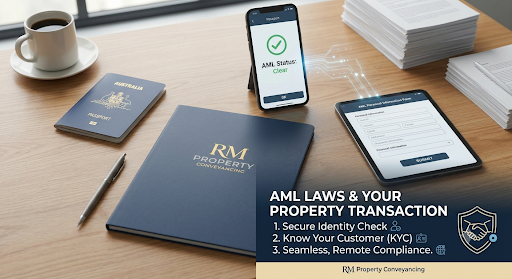
Anti-money laundering checks when buying or selling property: your questions answered
New AML/CTF laws mean every conveyancer now runs the same ID and source of funds checks on every client. Here’s what that means for your file, in plain English.
If you’re buying or selling with us, you may have noticed we’re asking for a bit more than we used to: extra ID checks, questions about where your funds are coming from, sometimes extra paperwork. It isn’t personal. It’s the law now, for every conveyancer, on every file.
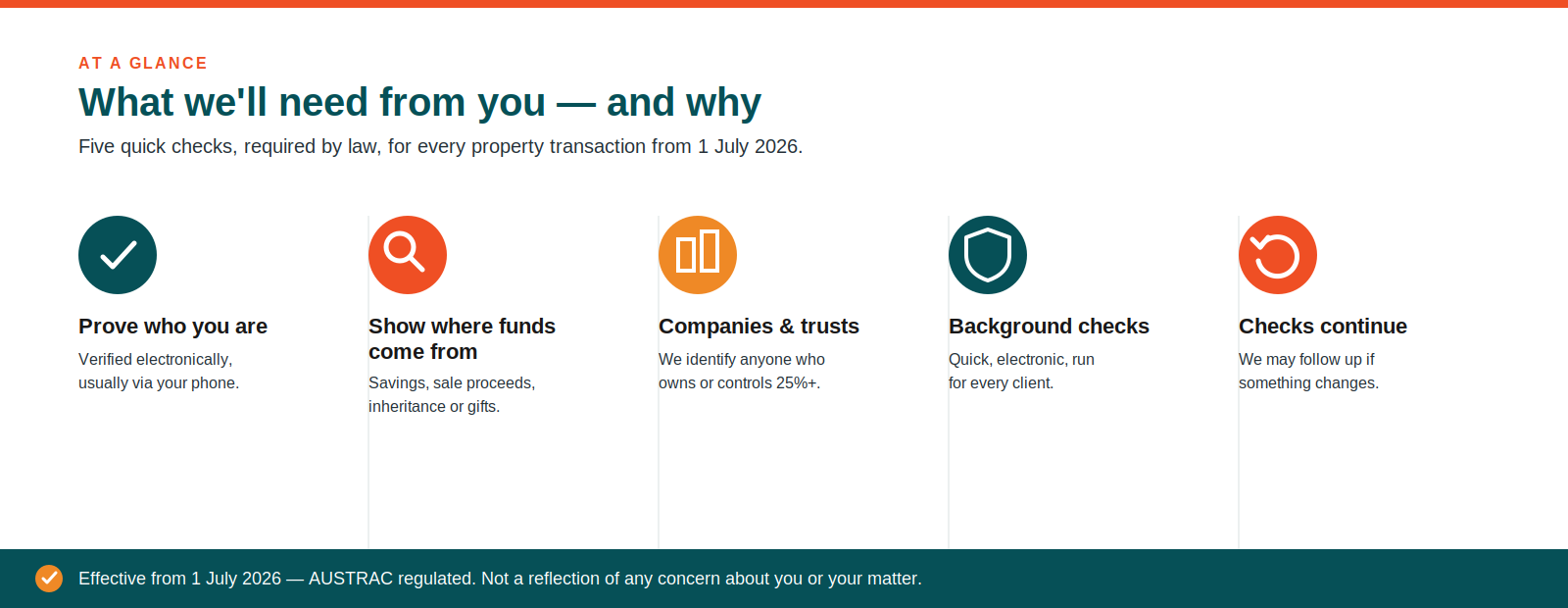
At a glance
- New AML/CTF laws require every conveyancer to verify identity and source of funds on every matter. There are no exceptions.
- Company, trust and SMSF purchases need beneficial owner checks for anyone controlling 25% or more of the entity.
- Have your ID and a source of funds explanation ready early. It’s the single best way to avoid delays.
Why am I suddenly being asked for more ID and information?
New anti-money laundering and counter-terrorism financing (AML/CTF) laws now apply to the property and legal services sector. Firms like ours are legally required to verify who our clients are and where their money is coming from, for every transaction, without exception. It’s not a reflection on you or your file. It’s simply how conveyancing now works across the industry.
The obligations started on 1 July 2026, and they now appear in the contract itself. Warning 13 on page 7 of the 2026 edition of the Contract for the Sale and Purchase of Land sets out that estate agents, solicitors, licensed conveyancers and other professions providing a designated service have regulatory obligations under the AML/CTF regime, including customer due diligence and reporting to AUSTRAC. So if you spot it while reading your contract, that’s what it’s referring to.
In plain English
Think of it like a bank asking where a large deposit came from. Nobody suspects you of anything. The rule exists because criminals used to hide money by buying property with it, so now every conveyancer has to ask every buyer and seller the same questions. You get asked. Your neighbour gets asked. We get asked when we buy our own homes.
What does identity verification actually involve?
We verify your identity electronically, usually via your phone, checking your details against government databases. Depending on your circumstances, we may need to ask for additional documentation beyond what we would have requested in the past.
“It’s not that we think you’re a criminal. The law now makes every conveyancer check everyone’s ID and money trail, on every deal, no exceptions.”
Why do you need to know where my money is coming from?
We’re required to ask every client to declare the source of their funds: savings, the sale of another property, an inheritance, a family gift, or something else. This applies across the board, regardless of how well we know you or how straightforward your purchase is.
I’m buying through a company, trust, or SMSF. Does anything change?
Yes. For purchases made through a company, trust, or self-managed superannuation fund, we’re required to identify the beneficial owners: anyone who controls 25% or more of the entity. We’ll guide you through exactly what’s needed for your structure.
Verifying identity and source of funds is now a standard step on every property transaction. It isn’t a flag on yours.
Are these checks only for certain clients?
No. We run automated checks against government watch lists for every client, on every matter, as standard practice. It’s a consistent process rather than something triggered by any particular concern about you.
Does this stop once my checks are done?
Not necessarily. Our obligations continue throughout your transaction. If circumstances change along the way, we may need to come back to you with follow up questions.
What happens if I can’t complete the checks, or something raises a concern?
If we’re unable to verify your identity, or our risk assessment raises concerns we can’t resolve, we may need to decline to act, or stop acting, for you. Any work already carried out remains payable under our cost agreement, and in some cases we may not be able to give a detailed explanation for the decision. This is a legal requirement, not a judgement call we make lightly.
Is my information kept private?
Yes. Your information is handled in line with the Privacy Act 1988. We store it securely, only share it where the law requires or permits, such as with AUSTRAC, and retain it for a minimum of seven years before it’s securely destroyed.
What should I do to help things move smoothly?
Have your ID and a clear explanation of your source of funds ready early on. If you’re buying through a company, trust, or SMSF, let us know upfront so we can advise exactly what’s needed for the beneficial ownership check.
What you will actually be asked to do
If you would rather skip the background and just get it done, this is the whole thing. Five steps, about five minutes, all on your phone.
Open the link we send you
- It arrives by email from InfoTrack, with a code sent to you by text.
- Tap Verify your identity, then Start.
Take a selfie
- Phone at eye level, plain wall behind you.
- Neutral face, no hat or glasses.
- Move the phone slowly closer until you get a green tick.
Photograph your ID
- Passport or birth certificate first. Lay it flat and take a clear photo.
- Then your driver licence as the second ID, including the back if asked.
Tell us where the money is coming from
- A line or two is enough: savings, the sale of another property, an inheritance, a family gift.
- We may ask for something that backs it up, such as a bank statement or the contract for the property you sold.
Check and submit
- Your name has to match on both IDs.
- Sign on screen with your finger, then tap Submit.
Stuck? Quick fixes
Camera will not open. Settings, then Camera, then Allow.
Glare detected. Step away from ceiling spotlights, or turn your flash off.
Names do not match. Have your marriage certificate ready to upload.
That is the identity half in short form. If you want the longer walkthrough, we have one here: Verification of Identity: a quick guide.
Questions about your file?
We’re happy to walk you through what’s needed for your specific matter.